Tag: testing

  • Diagnosis and Treatment of Infertility

    Most couples are advised to wait until they have been trying to conceive for at least a year, before seeking medical help, with the exception of couples over 35. Those that are over 35 or those that have reason to believe there may be a fertility problem should not wait a year before consulting a doctor.

    Infertility testing and treatment can be difficult and expensive. Before starting infertility testing, it’s best for couples to discuss how far they would be willing to go with testing and treatment. Only have testing for conditions that they are willing and financially able to have treated would help them move on to other options such as adoption.

    Diagnosis of infertility may take the use of a special doctor called an infertility specialist or a reproductive endocrinologist. Infertility is diagnosed after an infertility workup, which includes a physical exam of both partners to determine their general state of health. Many times, laboratory tests are conducted and sometimes both partners are interviewed about their sexual habits in order to determine whether intercourse is taking place properly for conception. If no obvious cause can be determined at that point, like improperly timed intercourse or absence of ovulation, more specific tests may be recommended.

    Depending on the test results of those tests, different treatments can be suggested. About 90% of infertility cases are treated with medication or surgery. Various fertility drugs may be used for women with ovulation problems. It’s important for couples to talk with their doctor about the drug to be used, so they understand the drug’s benefits and side effects. An x-ray of the fallopian tubes and uterus may be done after dye is injected, to show if the tubes are open and to show the shape of the uterus. An exam of the tubes and other female organs for disease may be done, using an instrument called a laparoscope to see inside the abdomen. If needed, surgery can be done to repair damage to a woman’s ovaries, fallopian tubes, or uterus.

    For a man, testing usually begins with a semen analysis, which looks at the number, shape, and movement of his sperm. Because semen is rather variable in quality, the test may be repeated. Sometimes other kinds of tests, such as hormone tests, are done.

    Depending upon the degree of abnormality, the treatment may range from relatively simple artificial insemination of the woman with the man’s semen (AIH), through conventional in-vitro fertilization and embryo transfer (IVF-ET), to the latest techniques of assisted fertilization by microinjection (ICSI). In infertile couples where women have blocked or absent fallopian tubes, or where men have low sperm count, in vitro fertilization (IVF) is an option. In IVF, eggs are removed from the ovary and mixed with sperm outside the body in a culture dish. After about 2 days, the eggs are examined to see if they have become fertilized by the sperm and are dividing into cells. These fertilized eggs (embryos) are then placed in the women’s uterus.


    Infertility and Women
    Infertility and Men

  • Your Physical and Emotional Symptoms

    In addition to cervical changes, temperature fluctuations, and changes in your cervical mucus during your monthly cycle, many women experience other fertility signals as well. Sometimes these additional symptoms are referred to as “secondary” fertility signs, because they don’t occur in all women, or even in every cycle in individual women. You can increase your chances of conceiving by familiarizing yourself with your emotional and other physical changes that occur each month and recording them on your chart in addition to your BBT, mucus and cervix signals. By doing this, you will get a more accurate picture of when you are most fertile.

    Physical Fertility Symptoms
    Emotional Fertility Signs

  • Fertility Charting Tools

    To chart your fertility, the only tools you need are a ‘calendar’ or fertility chart/graph and a basal body thermometer. Basal thermometers are more accurate than regular thermometers and are ultra-sensitive, tracking your body’s slightest temperature shift. Most digital basal thermometers come with a sample graph that can be enlarged and duplicated on any copy machine, or you can even download a printable chart on-line. Some women prefer to do their charting completely on-line, it’s just a matter of person preference.

    Record your observations and findings on your chart each day. If you tend to have very regular cycles each month, your charts may look strikingly similar. If your monthly cycles are irregular, you may gain a wealth of information by charting for an extended period of time.

    –Tracking your basal body temperature (or BBT)
    –Observing changes in your cervical mucus
    –Monitoring your physical and emotional symptoms
    –Checking the position and shape of your cervix

  • Emotional Fertility Signs

    For fertility, charting your mood swings, thoughts, emotions and energy level along with your cervical mucus and changes, your other physical changes and your BBT, you may discover that they are closely linked to possible conception. On the other hand, some women don’t notice cyclic mood and energy variations whatsoever.

    Estrogen rises and peaks as ovulation approaches, therefore many women experience increased sexual feelings, heightened desire, and more feelings of affection. This may be due in part to the increased slippery-feeling cervical mucus (which is similar to arousal fluid, but more watery) that is produced as ovulation draws near, causing increased libido on your most fertile days. It’s no coincidence that the word “estrogen”, the fertility hormone, stems from Latin roots which mean “creating mad desire.”

    Other secondary signs you may notice as ovulation approaches may include: increased energy level, heightened sense of vision, smell or taste, easier concentration and mood swings. After ovulation, as your fertile phase ends, you may suddenly feel depressed or let down. Many times you may experience a drop in your libido as well. These feelings are important signals and are good to note on your chart.

    Physical Fertility Symptoms

  • Cervical Mucus and Charting

    In conception, cervical mucus is an essential element because it nourishes and protects sperm, keeping them alive for up to five days inside your cervix, until ovulation occurs and fertilization can take place. Slippery cervical mucus also provides channels, which help sperm swim through your cervix. Without enough fertile mucus, your cervix is blocked and conception can’t happen.

    Whether your cycles are long, short, regular or irregular- charting your cervical mucus patterns (along with your BBT) is a great way to pinpoint your most fertile days and predict when you will ovulate, so you can be sure of which days lovemaking may result in pregnancy.

    In charting the changes in your cervical mucus, you will be looking for changes in consistency, quantity and color. The consistency of your cervical mucus changes throughout your menstrual cycle based on the hormonal shifts that are associated with ovulation, caused by estrogen and progesterone.

    Once your period has stopped, your cervical mucus is typically dry or it may feel dense, tacky, chalky or crumbly. The number of dry days after your menstrual bleeding ends, varies from cycle to cycle. Sperm are prevented from penetrating your cervix on days when there is no mucus. As you get closer to ovulation your cervical mucus will get thinner, because of increased levels of estrogen.

    Eventually, your cervical mucus turns to a consistency similar to raw egg whites (about 1-3 days prior to ovulation), which helps sperm to penetrate your cervix. This cervical mucus is very slippery and stretchy, sometimes changing in color, appearing fairly clear or yellowish. It may feel abundant, wet (similar to what you feel at the beginning of your period) and can be stretched into a thread between your fingers. This type of cervical mucus signals that eggs are developing and indicates that you are highly fertile. You and your partner should make love every day that you see or feel this type of fertile cervical mucus, for the best chance of conceiving.

    After ovulation you will notice that your cervical mucus typically gets thicker, sticky or dries up all together, becoming a protective barrier against sperm once again. This is caused by a decrease in your estrogen levels and an increase in your progesterone levels.

    You should start checking your cervical mucus on the first day after your period, and check it several times during the day. You can check it externally by wiping downward with toilet tissue, while sitting on the toilet. It can be more accurate to insert your index or middle finger (making sure your hands are clean), and observe your cervical mucus by feeling it and recording your observations on your chart.

    –Tracking your basal body temperature (or BBT)
    –Observing changes in your cervical mucus
    –Monitoring your physical and emotional symptoms
    –Checking the position and shape of your cervix

    Read more on Fertility Charting

  • Maternal Serum Alpha-Fetoprotein (MSAFP) Test

    Maternal Serum Alpha-Fetoprotein (MSAFP) Test

    This is a blood test which measures the level of alpha-fetoprotein (AFP) in your blood. It’s designed to indicate an increased risk for fetal open neural tube defects, such as spina bifida and may also indicate an increased risk for Down syndrome.

    With the MSAFP Test there is a possibility of a “false negative” as well as a “false positive”, since no screening test is perfect.

    This test is usually done between the 16th and 18th week of pregnancy.

    More Tests

    Amniocentesis
    Chorionic Villus Sampling (CVS)
    Contraction Stress test (CST)
    Glucose Tolerance Testing
    Hemoglobin Test
    Non-Stress (NST) Test
    Rh Factor
    Triple Screen Test
    Ultrasound

  • Hemoglobin Test

    Hemoglobin Test

    A protein found in red blood cells is called hemoglobin. By measuring your hemoglobin level during pregnancy, your doctor can determine whether you have anemia.

    If you do become anemic, your doctor will advise you about changes in your diet and may recommend an iron supplement.

    This test is normally done during your first prenatal visit, along with other lab work, but it may be done more often if you are found to be anemic.

    More Tests

    Amniocentesis
    Chorionic Villus Sampling (CVS)
    Contraction Stress test (CST)
    Glucose Tolerance Testing
    MSAFPT Test
    Non-Stress (NST) Test
    Rh Factor
    Triple Screen Test
    Ultrasound

  • Glucose Tolerance Test

    Glucose Tolerance Test

    This “Glucose Tolerance Test” is performed routinely to determine whether you have gestational diabetes.

    Gestational diabetes is a form of diabetes that can develop in a pregnant woman who didn’t have diabetes before pregnancy. It is caused by changes in a pregnant woman’s metabolism and hormone production.

    The risk of gestational diabetes is higher in women over 30, who have a family history of diabetes, or who are obese.

    A glucose tolerance test is usually done between the 24th and 28th weeks of pregnancy. You will be asked to drink a glucose solution and after an hour, blood is drawn and the glucose level is checked. About 15 percent of pregnant women who are given a glucose tolerance test will have abnormal levels and a second test is done.

    More Prenatal Tests

    Amniocentesis
    Chorionic Villus Sampling (CVS)
    Contraction Stress test (CST)
    Hemoglobin Test
    MSAFPT Test
    Non-Stress (NST) Test
    Rh Factor
    Triple Screen Test
    Ultrasound


  • Contraction Stress Test

    The “Contraction Stress Test” is another prenatal test used to help evaluate the condition of your baby and is often done when a non-stress test is non-reactive, or in some high-risk pregnancies to check whether the blood flow to the baby is adequate.

    Just like the non-stress test, the contraction stress test is done during the third trimester.

    The CST measures your baby’s heart rate in response to contractions of your uterus. The difference is that your doctor will be looking at the heart rate during uterine contractions, rather than in response to movements.

    More Tests

    Amniocentesis
    Chorionic Villus Sampling (CVS)
    Glucose Tolerance Testing
    Hemoglobin Test
    MSAFPT Test
    Non-Stress (NST) Test
    Rh Factor
    Triple Screen Test
    Ultrasound

  • Chorionic Villus Sampling (CVS)

    Chorionic Villus Sampling (CVS)

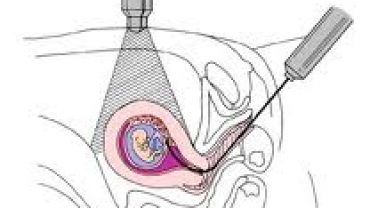
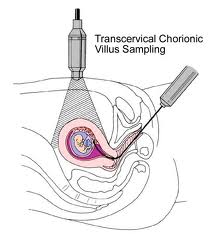
    Chorionic villus sampling is usually done early in pregnancy between the 9th and 13th week. This is a procedure that involves removing a sample of chorionic villi cells from the placenta at the point where it attaches to the uterine wall.

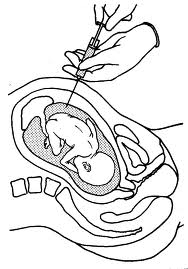
    In the more common trans-cervical method, ultrasound is used to guide a thin catheter through your cervix to the placenta. A small amount of chorionic villi cells are gently suctioned into the catheter. The trans-abdominal method is similar to amniocentesis and depends on ultrasound guidance. A long, thin needle is inserted through your abdomen into the placenta, where a small sample is withdrawn.

    CVS is done for many reasons, but the main reason is for early detection of chromosome abnormalities, such as Down syndrome and other genetic disorders. CVS cannot diagnose neural tube defects because it doesn’t sample any amniotic fluid for testing levels of AFP.

    The risk of a pregnancy ending in miscarriage are higher with CVS (one in 100) than with amniocentesis. Recent studies suggesting an association between CVS and limb malformation have made some doctors hesitant to offer this procedure.

    Since CVS provides a larger sample of cells than amniocentesis, results take a little less time to obtain. Some results may be possible within a day or two.

    More Prenatal Tests

    Amniocentesis
    Contraction Stress test (CST)
    Glucose Tolerance Testing
    Hemoglobin Test
    MSAFPT Test
    Non-Stress (NST) Test
    Rh Factor
    Triple Screen Test
    Ultrasound

  • Amniocentesis

    Amniocentesis

    The amniocentesis test is a test in which a needle is used to remove a sample of fluid from the amniotic sac surrounding your baby. The amniotic fluid, which contains cell shed by your baby, is then studied in a lab for analysis. If done for chromosome analysis, amniocentesis is usually performed after the 16th week of pregnancy. If a woman needs to give birth early for some medical reason, amniocentesis might be done shortly before delivery to asses fetal lung maturity.


    In the first half of your pregnancy, your doctor may offer amniocentesis if your baby is suspected to be at increased risk for chromosome abnormalities, inherited disorders or neural tube defects. A chromosome analysis will also establish the gender of your baby (but amniocentesis is not offered for gender determination along.)

    Amniocentesis is considered to be a relatively safe procedure. The risk of miscarriage caused by amniocentesis ranges from one in 200 to one in 400. In the rare instances tat amniocentesis causes a miscarriage, it is usually because an infection develops in your uterus, the water breaks or labor is induced prematurely. It is not uncommon for women to experience mild complications such as cramping or water leakage or discomfort around the needle site.

    The procedure takes about 45 minutes. Your abdomen is cleansed with antiseptic. Some doctors offer a local anesthetic, which can be injected near the site to numb your abdomen. A long, hollow needle is placed through your abdominal wall and into your uterus. A small sample of fluid is withdrawn. Usually the results are back within a few days, although some require up to a week to obtain.

    More Prenatal Tests

    Chorionic Villus Sampling (CVS)
    Contraction Stress test (CST)
    Glucose Tolerance Testing
    Hemoglobin Test
    MSAFPT Test
    Non-Stress (NST) Test
    Rh Factor
    Triple Screen Test
    Ultrasound

  • Prenatal Tests

    Prenatal Tests

    The use of prenatal tests has become available since the 1980s and it can provide valuable information about the health of your baby.

    Prenatal testing can be helpful in determining any special care your baby may require during pregnancy and after he or she is born.

    Knowing about birth defects before your baby is born can also help you and your partner prepare for any challenges ahead.

    As you consider which prenatal tests are appropriate for you, think about the risks and benefits of each.

    Types of Prenatal Tests

    Amniocentesis
    Chorionic Villus Sampling (CVS)
    Contraction Stress test (CST)
    Glucose Tolerance Testing
    Hemoglobin Test
    MSAFPT Test
    Non-Stress (NST) Test
    Rh Factor
    Triple Screen Test
    Ultrasound